


How should I invest for high inflation?
A conversation with the &Partners Investment Team


Key takeaways
- No single asset class has reliably protected investors against high inflation, historically
- Some common claims about how to invest for high inflation don’t hold up under scrutiny
- We believe a diversified portfolio is the best approach
Inflation is high and seems likely to stay that way, leading many investors to wonder if their portfolios are prepared. To help answer that question, the &Partners Investment Team dove into the historical record. They analyzed past high-inflation eras to see which asset classes beat inflation and which didn’t keep up.
Here’s what Fredrik Axsater and Erik Baas found — and what it means for investors.
Why did you analyze how asset classes performed during high-inflation periods?
Fredrik: Inflation is relatively high right now, of course, and that looks likely to continue. And inflation has a corrosive impact on returns, so it’s important for investors to understand it.
Say you spend $200,000 per year. With a 3% inflation rate, your costs might be more than $360,000 in 20 years. If inflation averages 4%, your costs could be more than $430,000. Your plan needs to account for that risk.
Erik: And there’s a lot of misinformation out there. Many popular beliefs about how to invest for high inflation are simplistic and don’t have much evidence behind them.
We wanted to identify what has worked, historically, and what hasn’t, so we looked at asset class performance during five extended periods when annual inflation was above 4%.
What jumped out at you from the research?
Fredrik: One big finding was that you couldn’t just rely on gold, commodities, or TIPS [Treasury Inflation-Protected Securities] to perform well when inflation was high.
- Gold trailed inflation in two of the five periods. In one period it lagged inflation by more than 19% per year. If you were counting on gold to outperform, you would have been in trouble.
- Commodities have a reputation as inflation-beaters, but they lagged inflation in three of the five periods we reviewed.
- TIPS may seem like an ideal inflation hedge, but they had mixed results in the two high-inflation periods since they were introduced.
As we noted in our Prism market outlook, the key point is that there’s no one silver bullet to manage inflation. You can’t have confidence in any of the rules of thumb.
Erik: At the same time, some asset classes performed surprisingly well.
People tend to think cash and Treasuries are very vulnerable to high inflation, but they both beat inflation in three of the five periods we reviewed. These asset classes may outperform even in high-inflation periods, depending on the level of interest rates and changes in bond yields.
The best inflation protection has been a diversified portfolio
Our analysis of past high inflation periods found no one asset class reliably beat inflation, but a diversified portfolio gave investors a good chance to stay ahead of it.
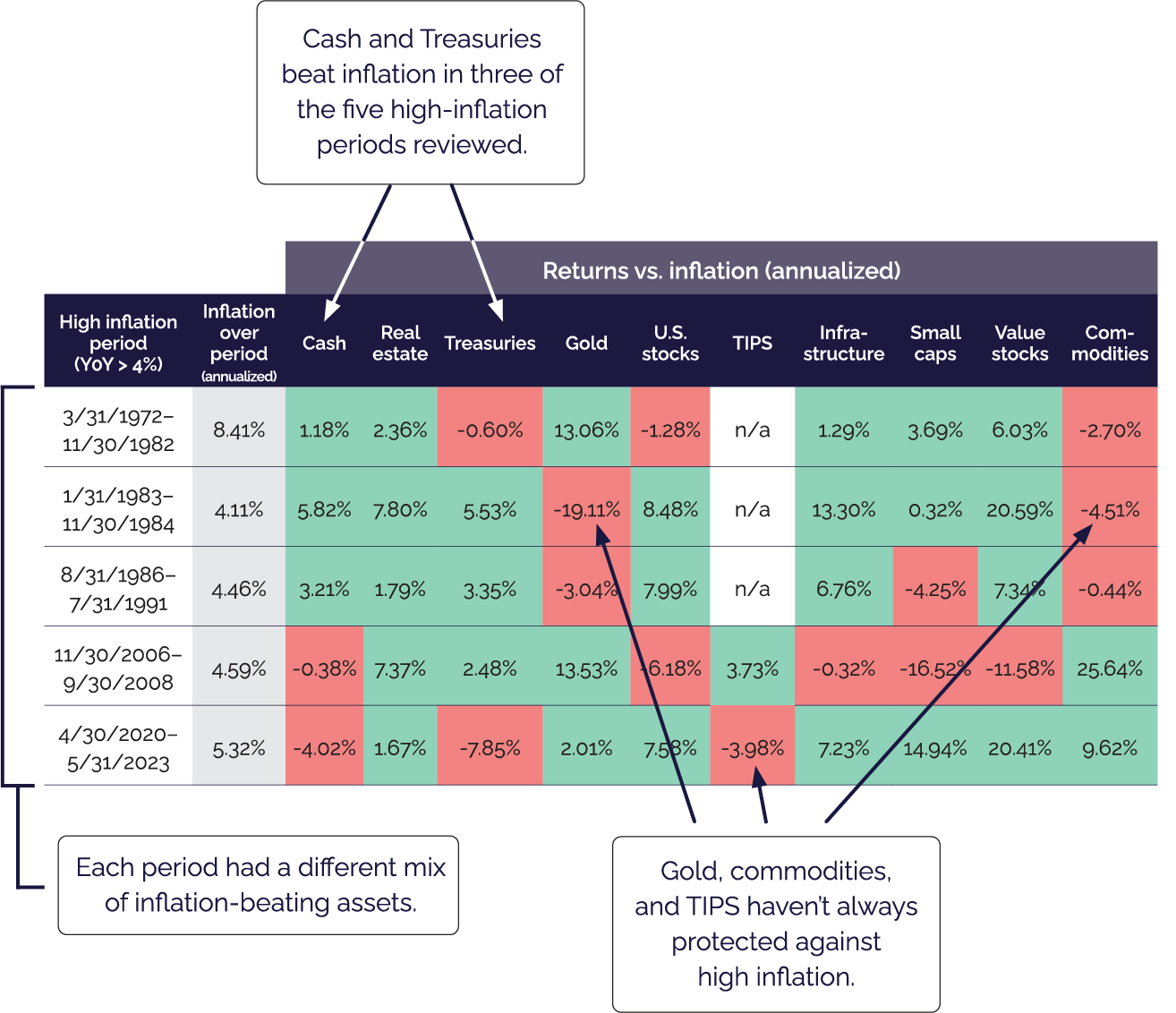
Source: Bloomberg, May 28, 2026. Cash return measured by effective federal funds rate. Real estate return measured by FTSE Nareit Equity REITs Index (1972–1978) and NCREIF Property Index (1978–present). Treasury return measured by Robert J. Shiller Database (1972–1973) and Bloomberg U.S. Treasury Index (1973–present). Gold return measured by gold spot price. U.S. equity return measured by S&P 500. TIPS return measured by Bloomberg U.S. Treasury Inflation Notes Index. Infrastructure return measured based on 25% energy and 75% utilities industry portfolios from CRSP database, sourced from the Kenneth French data library at Dartmouth (1972–2003) and the DJ Brookfield Global Infrastructure Index (2003–present). Small-cap equity return measured by 1st Size Quintile Portfolios from CRSP database, sourced from the Kenneth French data library at Dartmouth. Value stock return measured by 1st Value Quintile Portfolios from CRSP database, sourced from the Kenneth French data library at Dartmouth. Commodities return measured by the S&P GSCI Index. Past performance is not indicative of future results.
How have equities performed historically amid high inflation?
Fredrik: Stocks — whether you’re talking about broad U.S. equities, small caps, or value stocks — beat inflation in most high-inflation periods, but not all.
Equities have some fundamental advantages when it comes to managing high inflation. Businesses can adapt to change. They may be able to adjust how they price their goods, their input costs, and other variables to try to protect their profits, stock prices, and dividends.
Erik: Some stocks are more vulnerable to inflation than others, though. Many companies these days have high valuations that are based on optimistic assumptions about what their cash flows may be worth in 10 or 15 years. For those stocks, even a small increase in expected inflation can have a big negative impact on returns.
Why haven’t asset classes performed more consistently in high-inflation periods?
Erik: The simple answer is that every period is different. Lots of factors other than inflation affect returns: corporate profits, economic growth, interest rates, geopolitics, valuations, new technologies … the list goes on and on.
The reason inflation is high can affect asset class performance, too. Sometimes inflation is caused by very strong demand. That environment might boost corporate profits and help stocks advance, but defensive investments like bonds might struggle.
Other times, inflation is caused by shortages of key supplies such as oil. Stocks may come under pressure as rising costs hurt corporate profits, but commodity prices might rise.
Fredrik: Timing and investor expectations also can affect asset class returns. In 2021 and 2022, the Federal Reserve thought high inflation would be “transitory” and come down quickly. It wasn’t, and it didn’t. The Fed had to keep interest rates high for longer than many people expected, and that hurt certain asset classes, especially real estate.
I’m glad you mentioned real estate. It was the one asset class that outperformed inflation in every period you reviewed. Why isn’t real estate the silver bullet against high inflation?
Erik: Real estate is a valuable part of a diversified portfolio, and it can help manage inflation, but it comes with trade-offs.
For one thing, real estate is highly sensitive to real interest rates [the level of interest rates minus inflation]. Real interest rates usually are low to start high-inflation eras, then rise as the Fed raises rates to bring inflation under control. These dynamics mean real estate often performs well at first and then struggles.
Take the COVID era. Real interest rates were below zero in April 2020, and real estate gained 30% through September 2022.1
Then the Fed hiked rates and inflation started to come down. Real interest rates rose from less than 0% to more than 2%. That was bad news for real estate, which fell 12% between September 2022 and June 2024.
Why not just hold real estate when real rates are low and sell before they rise?
Fredrik: Unfortunately, that’s not usually possible. Most real estate investments are private and illiquid. It’s especially hard to sell at a good price when the market is under stress, which it might be if investors think real rates are going to climb.
You can invest in public real estate investment trusts, or REITs, which are more liquid. But their prices tend to reflect concerns about higher real rates very far in advance. To time your sale right, you’d need a crystal ball to figure out what inflation and real rates might be in a year.
What are the big takeaways for investors?
Fredrik: The most important takeaway is the power of a diversified portfolio for managing inflation. You can’t count on any one asset class to outperform when inflation is high. But historically, you have a good chance of staying ahead of inflation if you’re well diversified.
We saw something really interesting when we examined how a diversified portfolio might have performed in each high-inflation era. In every period we reviewed, five to seven asset classes beat inflation. But the mix of inflation-beating assets was different every time.
Take the two most recent periods, starting in 2006 and 2020. A well-diversified portfolio could have helped manage inflation in either period. But only three asset classes outperformed inflation both times, so concentrating in any one asset class would have been risky. Again, there’s no one recipe for managing inflation. No one knows in advance which asset classes will outperform. We think staying broadly diversified can help stack the odds in your favor and give you a better chance to achieve your goals.
1. Real estate returns based on the NCREIF Property Index.

Fredrik Axsater* is a partner at &Partners, leading its Investment Team and serving as lead portfolio manager for the &Partners Core-Satellite Portfolios. Over the course of his career, he has held senior roles in portfolio management, retirement solutions, and institutional strategies at BlackRock and State Street, and served as CEO of LGM, an emerging market equity boutique owned by BMO Global Asset Management. He holds a BS in electrical engineering from the University of San Diego, an MBA from the University of Illinois, and the CFA designation.

Erik Baas is a partner at &Partners and a member of its Investment Team, where he develops innovative, holistic portfolio strategies tailored to the needs of advisors and their clients. With over 10 years of experience, Erik has managed large, complex institutional portfolios and delivered customized solutions for individual clients. His previous roles have including working as an investment and asset allocation manager at Germany’s sovereign wealth fund (Kenfo) and as an investment officer at one of Germany’s largest multifamily offices. He holds degrees from the University of Tübingen and the CFA and CAIA designations.
*Third-party consultant affiliated with &Partners
Reprinted with permission from Financial Advisors IQ ThinkTank.
The &Partners Investment Team is a group within &Partners composed of experienced asset management professionals that serves as a resource for &Partners, LLC and its financial professionals. The opinions of the &Partners Investment Team expressed herein: (i) may not reflect the individual opinions of the financial professional(s) servicing your account(s); and (ii) are not intended as, and may not be relied on in any manner as, legal, tax, or investment advice, a recommendation, or as an offer or solicitation to buy or sell any security, financial product, or instrument, or otherwise to participate in any particular trading strategy.
Please review the Additional Important Disclosures below which address the opinions, strategies, investments, indexes, and other topics addressed herein. MR9080118.1.
There are a number of considerations and different types of investments, strategies, and programs that are neither suitable for nor available to all investors. Consequently, this material does not intend to address the financial objectives, situation, or specific needs of any individual investor. You should consult with your financial professional before investing and with your accounting and tax advisors to understand the tax implications of any investment or investment transaction(s) in connection with your specific situation.
Different types of investments and investment strategies inherently carry different or greater risks than others.
With all investments, past performance may not be indicative of future results, and it is possible that you may lose some or all of your investment. Additionally, certain investments may have limited liquidity, or may become illiquid, so you should consider your potential capital and liquidity needs before investing.
The information and opinions herein are point-in-time, as of the date of publication, and are based on certain current assumptions and views that are all subject to change. Before acting on any information, please consult with your financial professional(s) to assure any changes to your portfolio are appropriate for your goals and circumstances at that time.
Investment and portfolio diversification is generally recommended to reduce the overall volatility of a portfolio, but diversification will not assure a gain or prevent a loss (especially in declining markets).
Diversification is generally more effective to reduce volatility when a portfolio includes investments that are uncorrelated or negatively correlated with one another from a performance and investment risk standpoint.
Historical correlation of investment performance correlation (or lack thereof) is, by its nature, backward-looking and does not guarantee the correlation (or lack thereof) will continue or remain constant.
This material has been prepared on the basis of publicly available information, internally developed data, and other third-party sources believed to be reliable, but neither &Partners nor any of its affiliates guarantee its accuracy. &Partners has not sought to independently verify information taken from public and third-party sources. Charts and graphs provided herein are for illustrative purposes only.
Small-cap, mid-cap, high-yield fixed-income, options, international, currencies, commodities, and commodities-based securities (including, but not limited to, commodity-related and/or real estate-related securities) investments will typically have greater volatility and carry other unique risks that may make them more susceptible to loss.
Different types of investments and investment strategies inherently carry different or greater risks than others.
With all investments, past performance may not be indicative of future results, and it is possible that you may lose some or all of your investment. Additionally, certain investments may have limited liquidity, or may become illiquid, so you should consider your potential capital and liquidity needs before investing.
Investments in fixed-income securities, including bonds and municipal securities, are subject to issuer, credit rate, interest rate, liquidity, inflation, prepayment, extension, and other similar risks that will affect the market price of those investments. Bond pricing will generally fluctuate inversely with changes to interest rates, but not all bonds follow the same patterns depending on specific bond terms and other risk considerations.
It is important that you review any prospectus or other offering materials for applicable investments prior to investing.
It is not possible to invest directly in an index. Indexes are unmanaged and do not reflect the deduction of fees or expenses. All investments are subject to risks, including the risk of loss. Past performance is not indicative of future results.
The S&P 500® is widely regarded as the best single gauge of large-cap U.S. equities. The index includes 500 leading companies and covers approximately 80% of available market capitalization.
The FTSE Nareit Equity REITs Index contains all Equity REITs not designated as Timberland REITs or Telecommunications REITs. Prior to December 2010, the index included Timberland REITs and Telecommunications REITs.
NCREIF Property Index: This flagship index tracks the quarterly, unleveraged total return of operating, institutional-quality commercial properties (hotels, offices, industrial, retail, and apartments).
The Bloomberg U.S. Treasury Index measures U.S. dollar-denominated, fixed-rate, nominal debt issued by the U.S. Treasury.
The Bloomberg Barclays Capital U.S. Treasury Inflation-Protected Securities (TIPS) Index (Series-L) includes all publicly issued U.S. Treasury inflation-protected securities that have at least one year remaining to maturity, are rated investment grade, and have $250 million or more of outstanding face value.
The S&P GSCI is the first major investable commodity index. It is one of the most widely recognized benchmarks that is broad-based and production weighted to represent the global commodity market beta. The index is designed to be investable by including the most liquid commodity futures and provides diversification with low correlations to other asset classes.
The views and opinions expressed are for informational and educational purposes only as of the date of production/writing and may change without notice at any time based on numerous factors, such as market or other conditions, legal and regulatory developments, and additional risks and uncertainties and may not come to pass. This material may contain “forward-looking” information that is not purely historical in nature.
Such information may include, among other things, projections, forecasts, estimates of market returns, and proposed or expected portfolio composition. Any changes to assumptions that may have been made in preparing this material could have a material impact on the information presented herein by way of example. Performance data shown represents past performance and does not predict or guarantee future results.
All information has been obtained from sources believed to be reliable, but its accuracy is not guaranteed. There is no representation or warranty as to the current accuracy, reliability, or completeness of, nor liability for, decisions based on such information and it should not be relied on as such.
Investing involves risk; loss of principal is possible. Investors should be aware that alternative investments are speculative, subject to substantial risks including the risks associated with limited liquidity, the potential use of leverage, potential short sales, and concentrated investments and may involve complex tax structures and investment strategies. Alternative investments may be illiquid, there may be no liquid secondary market or ready purchasers for such securities, they may not be required to provide periodic pricing or valuation information to investors, there may be delays in distributing tax information to investors, they are not subject to the same regulatory requirements as other types of pooled investment vehicles, and they may be subject to high fees and expenses, which will reduce profits.
Related content

Positioning portfolios for higher inflation
Take a holistic approach to managing inflation, and other investment recommendations for the second half of 2026.

Rapid Response SpaceX IPO
The largest IPO in history is here. Explore the key drivers, market dynamics, and investment implications of SpaceX’s debut.