


Rapid Response: Back to bAIsics


Amid growing concerns about the sustainability of AI capital spending and deteriorating investor sentiment, we recommend that investors maintain a long-term perspective and diversify rather than bet on specific outcomes.
What has happened
Over the last few weeks, sentiment toward artificial intelligence (AI) has deteriorated, with significant volatility across some of the most well-known hyperscalers and other AI-related companies. The most high-profile example is Alphabet, which experienced its largest one-day stock price decline in history on October 29.
The concern is that AI capital expenditures (capex) are consuming cash faster than they are generating returns. The problem is not that AI demand is absent, but rather that the cost of building AI infrastructure is cannibalizing free cash flow. In some cases, the core legacy businesses funding the buildout are themselves showing signs of stress. For example, Alphabet is experiencing slowing growth in its core search and advertising business, and AI may be contributing to that slowdown.
Deteriorating sentiment is also evident in the fixed-income market, where, as of October 30, investment-grade technology bond spreads stood at 1.02 percentage points over comparable Treasuries — about 15 basis points wider than the broader investment-grade market and the weakest relative level in more than two decades.1
During the ongoing Q3 earnings season, concerns about earnings quality have also increased, as 2026 earnings are increasingly influenced by cross-holdings in other companies.2 For example, Alphabet, having benefited from substantial paper gains on its investments in Anthropic and SpaceX in Q1 and Q2, recorded an $8.7 billion paper loss on its investment portfolio in Q3, with the declining value of its SpaceX investment accounting for most of the loss.
These two concerns have had ripple effects across related market segments, including semiconductor companies. On October 30, AMD fell nearly 11%, while the Bloomberg Philadelphia Semiconductor Index declined 7.2% in a single day.
What has not happened
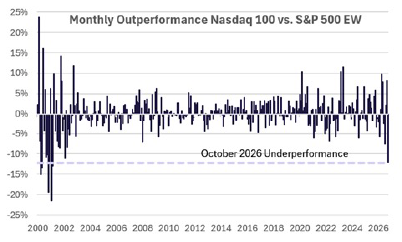
The broader market has not broken down. The equal-weighted S&P 500 is holding up, and the selloff remains concentrated in AI-exposed mega caps. In fact, during October, the S&P 500 Equal Weight Index rose 4.9%, while the cap-weighted S&P 500 declined 0.93% and the tech-heavy Nasdaq-100 fell more than 6.6%. The difference in monthly returns between the Nasdaq-100 and the S&P 500 Equal Weight Index was the largest in approximately 25 years, as illustrated in the following chart.
Our view: Diversify rather than bet on outcomes
A portfolio dominated by a single sector, theme, asset class, or market outcome represents a concentrated bet rather than a diversified investment strategy. We recommend maintaining genuine diversification across strategies, sectors, and return drivers to help mitigate the impact of a reversal in today’s market leaders.
As discussed in our recent Prism market outlook, you might be reluctant to trim a winning investment — perhaps due to familiarity with the company, fear of missing out on further gains, concerns about the tax implications of selling, or simply inertia. But bear in mind that leading stocks don’t keep leading indefinitely, and substantial losses can follow substantial gains. Consistently identifying the right entry and exit points is extremely difficult, making disciplined strategic allocations more reliable than tactical predictions.
Getting the timing wrong can have detrimental effects on wealth creation. As of October 30, the S&P 500 had delivered a 76% total return over the previous five years. Missing just the 10 best days during that period would have reduced the total return to less than 21%. This illustrates the risks of attempting to time the market rather than maintaining a diversified portfolio. As always, we recommend taking a long-term view. Portfolio construction should focus on achieving long-term objectives rather than reacting to short-term market leadership.
- Bloomberg, “High-Grade Tech Bond Spreads Are Weakest in Decades on AI Deluge,” October 30, 2026.
- Bloomberg, “Amazon and Intel Tank the AI Trade. The One Factor Linking Big Tech’s Underwhelming Earnings,” October 30, 2026.
&Partners Investment Team
The &Partners Investment Team brings extensive experience, deep market knowledge, and a disciplined approach to managing capital.
In keeping with our mission to bring institutional-quality research, analysis, and investment strategies to financial advisors and their clients, our Investment Team is readily accessible to &Partners’ advisor community. This concierge approach allows us to provide personalized investment guidance that supports advisors in helping them achieve their financial goals.
*Fredrik and Alan are third-party consultants affiliated with &Partners.
Disclosures
Investment and portfolio diversification is generally recommended to reduce the overall volatility of a portfolio, but diversification will not assure a gain or prevent a loss (especially in declining markets). Diversification is generally more effective to reduce volatility when a portfolio includes investments that are uncorrelated or negatively correlated with one another from a performance and investment risk standpoint. Historical correlation of investment performance correlation (or lack thereof) is, by its nature, backward looking and does not guarantee the correlation (or lack thereof) will continue or remain constant. Diversification and strategic asset allocation do not assure profit or protect against loss in declining markets.
The material has been prepared or is distributed solely for informational purposes and is not a solicitation or an offer to buy any security or instrument or to participate in any trading strategy. Please consult with your financial professional to determine what might be appropriate for your situation. Past performance is not indicative of future results.
It is not possible to invest directly in an index. Indexes are unmanaged and do not reflect the deduction of fees or expenses. All investments are subject to risks, including the risk of loss.
The S&P 500® is widely regarded as the best single gauge of large-cap U.S. equities. The index includes 500 leading companies and covers approximately 80% of available market capitalization.
The S&P 500 Equal Weight Index (EWI) is the equal-weight version of the widely used S&P 500. The index includes the same constituents as the capitalization-weighted S&P 500, but each company in the S&P 500 EWI is allocated a fixed weight, or 0.2% of the index total at each quarterly rebalance.
The Philadelphia Semiconductor Index is a modified market capitalization-weighted index composed of the 30 largest U.S.-listed semiconductor companies involved in the design, distribution, manufacturing, and sale of microchips and semiconductor equipment.
The Nasdaq-100 Index® includes 100 of the largest domestic and international non-financial companies listed on the Nasdaq Stock Market based on market capitalization. The index reflects companies across major industry groups including computer hardware and software, telecommunications, retail/wholesale trade, and biotechnology. It does not contain securities of financial companies including investment companies.
&Partners℠ is the enterprise trade/marketing name for Ampersand Partners LLC, a Delaware limited liability holding company, and its subsidiary, &Partners LLC, a Tennessee limited liability company. Securities and advisory services offered through &Partners LLC, member FINRA, SIPC. MR9213158.1.
Related content

How should I invest for high inflation?
In past high-inflation periods, which asset classes beat inflation and which didn’t keep up? The &Partners Investment Team weighs in.
Rapid Response SpaceX IPO
The largest IPO in history is here. Explore the key drivers, market dynamics, and investment implications of SpaceX’s debut.